Somewhere in your forties, the rules quietly changed.
Your go-to workout stopped delivering. Sleep that used to come easily now shatters at 3 a.m. Your joints ache for reasons you can’t name. And a layer settled around your middle without a single change to how you eat.
Here’s the reframe I want you to hold onto:
You are not failing your lifestyle. Your lifestyle was never designed for your new physiology.
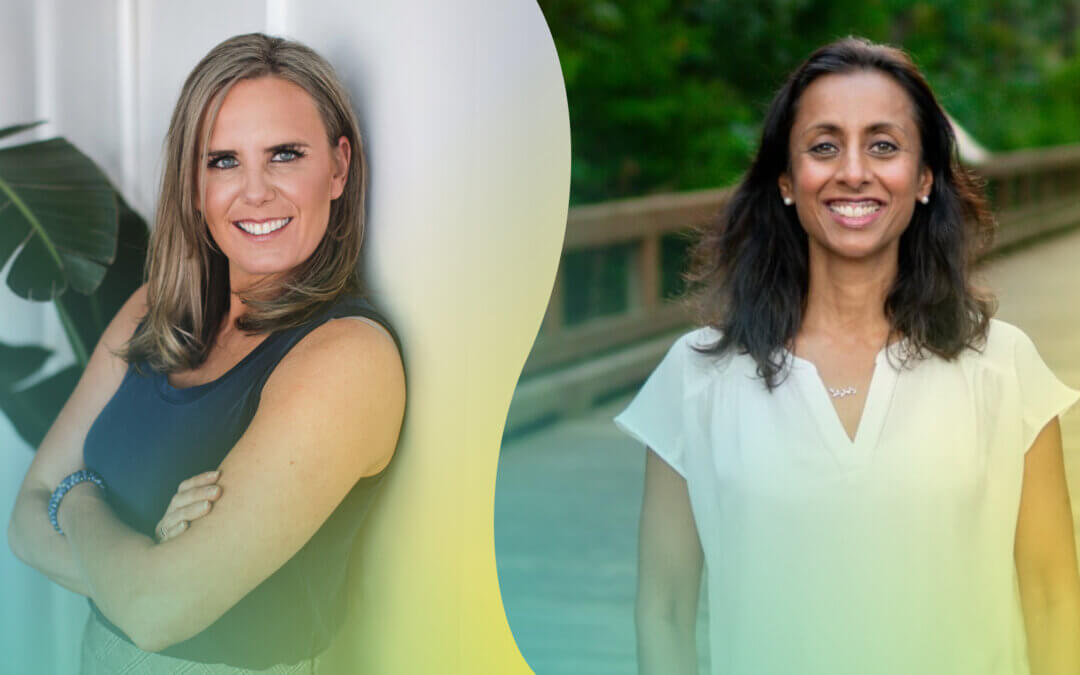
I’m Dr. Heather Hammerstedt – emergency medicine physician, lifestyle medicine doctor, and founder of Wholist. I recently sat down with my friend Dr. Rashmi Schramm on her Inner Peace and Power podcast to talk through exactly this: what’s really happening in perimenopause and menopause, and what actually helps. It was one of my favorite conversations on midlife health in a long time – warm, a little irreverent, and refreshingly free of hype.
🎧 Listen to the episode: Mood, Memory, Muscle and Menopause with Dr. Heather Hammerstedt – Inner Peace and Power Ep. 137 »
If you’ve felt like you’re doing everything “right” and still losing ground, this one’s for you. Here are the ideas I most want you to walk away with.
First, a word about the noise
Menopause is having its moment, and that’s mostly good news. More conversation, more research, more attention on a transition women were told to simply endure.
But attention attracts marketers.
Menopause is now a $30 billion industry, and I’ll say it plainly: we are an easy mark. Not because we’re naive. Because we’re uncomfortable, and the algorithm is very good at finding the exact spot where it hurts.
My rule of thumb is simple: if it’s quick, easy, and costs a lot of money, it’s probably not what you need.
A clinic that wants a thousand dollars in lab work before they’ll talk to you, a shelf of supplements, a “protocol” with a big price tag – those are red flags, not solutions. Real menopause care, including hormone therapy when it’s appropriate, shouldn’t cost you an arm and a leg.
If you’re looking for legitimate help, look for practitioners certified through the Menopause Society (the MSCP credential after their name), or clinicians trained through respected menopause educators. You may pay cash for the visit, but the actual medicine shouldn’t break the bank.
This isn’t cynicism. It’s discernment. You deserve evidence, not a pitch.
The reframe: your body changed the rules
Here’s the part I want you to read twice.
The reason your old habits stopped working isn’t a character flaw. It’s physiology. Estrogen is declining, and estrogen was quietly running a lot more than your menstrual cycle.
So here’s my honest starting point:
You can’t just eat less and move more anymore. That advice was written for a body you no longer have.
That’s not a reason to despair. It’s permission to stop blaming yourself and start working with the body you actually have now. You are not a helpless victim of this transition. You still have agency. The moves just have to match the new physiology.
The four shifts no one warned you about
Perimenopause goes so far beyond hot flashes. There are four underappreciated areas where estrogen’s decline shows up, and where your lifestyle has real leverage.
1. Your brain. We have estrogen receptors throughout the body, and a lot of them live in the brain. That’s why this stretch of life brings brain fog, slower recall, and a rise in anxiety or low mood for so many of us. It isn’t “just stress.” It’s neurobiology.
2. Your sleep. The architecture of sleep itself changes. This is bigger than night sweats – your ability to drop into deep, restorative sleep gets disrupted. And sleep is the floor everything else stands on. You can’t lose weight, train, or think clearly on a broken night.
3. Your muscles and joints. That new, achy stiffness isn’t always arthritis or “just getting older.” There are estrogen receptors in your tendons and joint capsules, and when estrogen drops, they hurt. I had a full autoimmune panel run on me before I realized my own aches were perimenopause, and I see this constantly. Dr. Vonda Wright even named it: the musculoskeletal syndrome of menopause.
4. Your weight – and where it lives. The scale may not move much, but the distribution does. As estrogen falls, insulin resistance rises, your appetite hormones shift, and fat starts settling centrally, around your organs. Pair that with roughly 1% muscle loss per year once perimenopause begins, and the whole equation changes.
One percent a year is not small. Which brings me to the good news: two of the most powerful counter-moves are entirely in your hands.
Protein, reconsidered
If you take one nutrition idea from me, make it this: protein isn’t about chasing muscle, it’s about defending it.
When you’re losing muscle every year, protein is the repair material that helps you hold the line. But let me puncture the Instagram version of this advice.
You do not need 150 to 200 grams a day.
Honestly, you’d have to quit your job and get rid of your children to eat that much. And piling on protein doesn’t magically build muscle – protein is the helper, resistance training is the stimulus.
The number that matters is distribution.
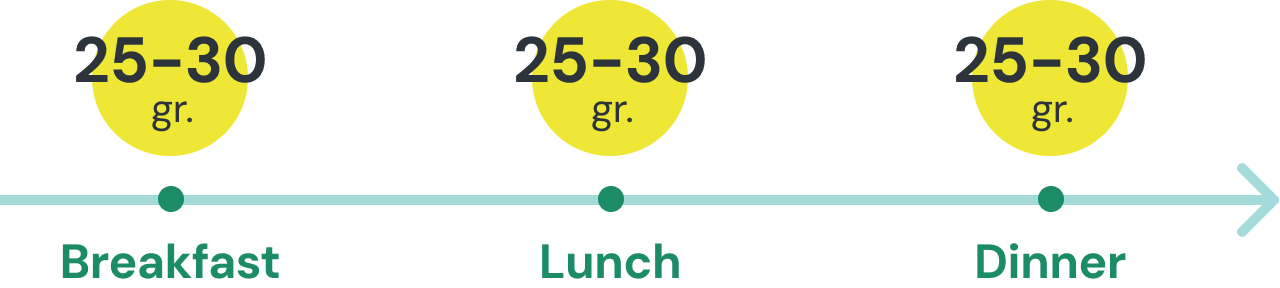
We build muscle when we cross a “leucine threshold” at a given meal, and that threshold rises as we age. So the goal isn’t one giant protein dose. It’s around 25 to 30 grams of protein per meal, spread across the day. Steady signals, meal after meal.
And you can absolutely hit this on a plant-based plate. I just want you to be a little more intentional – variety of colors, variety of complex carbohydrates, and time-honored combinations like rice and beans that give you a complete protein. Whatever you eat, the north star is the same: choose the least-processed option in front of you, get your protein, then your fiber, then good fats. That combination is what keeps you full and steadies your blood sugar.
Resistance training is medicine
This is the line I’ll repeat until you’re tired of hearing it:
Resistance training isn’t a suggestion. It’s a prescription.
I make the case on three fronts.
Metabolically, muscle works for you all day. More muscle means a higher resting burn, hour after hour – unlike cardio, which stops paying out the moment you step off the treadmill. There’s even a lovely mechanism here: little GLUT4 receptors in your muscle help manage blood glucose without leaning on insulin, which is exactly the help a midlife body needs as insulin resistance climbs.
For your bones, every time you load a muscle, you tug on the bone it’s attached to, and the bone rebuilds itself stronger. That’s real protection against the fracture risk that climbs after menopause. I always say grandma’s three classic emergency-room diagnoses are UTIs, heart attacks, and hip fractures – and thoughtfully treating perimenopause and menopause can help prevent all three.
For your mind, the research shows strength training can rival medication for symptoms of depression and anxiety. It genuinely changes your brain chemistry, not just how you feel about your reflection.
And no, you will not get “bulky.” You don’t have the hormonal profile for it. What you get is stronger, more capable, more toned – able to carry the groceries, the kids, the grandkids, and stay on your feet as you age.
Two to three sessions a week, gradually getting a little heavier over time. It doesn’t have to be fancy. But it isn’t optional.
Sleep is a lever, not just a symptom
Sleep in midlife is both a casualty and a cause. Even mild sleep loss can drive insulin resistance on its own and scramble the hormones that govern hunger and stress.
So protecting your sleep is protecting everything downstream.
A few of the moves I lean on: swap harsh blue light for warm red light at night, get sunlight on your eyes within about fifteen minutes of waking (no sunglasses for those first minutes), pull heavier carbohydrates earlier in the day, and know that cognitive behavioral therapy for insomnia (CBT-I) can outperform medication.
But maybe the most freeing idea is the gentlest one.
It is normal to wake up in the night.
A sleep specialist taught me this, and it changed everything: waking several times, or having one night run 90 minutes shorter than the last, is simply normal. Once you believe that, the 3 a.m. wake-up loses its grip. You don’t stare at the clock. You don’t spiral into tomorrow’s to-do list. Your cortisol stays low, and you drift back to sleep. Think of it as your own bedside cognitive behavioral therapy.
The real prescription: simplify
For all the mechanisms and receptors, my closing message is disarmingly simple.
Take away the noise. The supplements, the gadgets, the ten thousand competing protocols.
Come back to four questions: hormones or not, how am I moving, how am I sleeping, and how am I fueling myself?
Lift something heavy, then something heavier next time. Choose the least-processed food. Protein and fiber first. Protect your sleep. And – this part matters – give yourself grace.
Because somewhere in this transition, so many women lose a little faith in themselves, in a hundred small ways the world is happy to encourage. Getting back to the simple, science-backed basics is how you get that self-trust back.
And don’t forget to laugh. When Dr. Rashmi asked me about “lightness of being,” my answer was to find the one moment of real connection or humor in a hard situation – in the ER, in a coaching session, at home with my twin teenage boys. The shortest distance between two people, as Dr. Rashmi put it, is laughter.
Your next step
You don’t have to navigate midlife by trial, error, and marketing.
At Wholist, this is exactly the work my team and I do: helping midlife women trade the noise for a plan grounded in real science, real psychology, and real nourishment – no counting, no products, no BS. Our coaches carry professional medical backgrounds, and everything we teach is built for the body you have now, not the one you had at thirty.
If you’re ready to simplify and actually feel the difference, start here:
- Listen to the full episode: Mood, Memory, Muscle and Menopause on Inner Peace and Power »
- Explore our Weight Wellness coaching » or Total Health Mastery »
- Want to reset first? Try the 6 Day Midlife Metabolism Reboot »
Your physiology changed. Your ability to thrive didn’t. Let’s work with the body you have now.
— Dr. Heather